Electrical Stimulation
Electrical stimulation is a form of neurotechnology where small electrical pulses are sent to certain areas of the nervous system in order to influence them in a way that is helpful to the patient. These implants can be completely internal or can have external remotes or receivers, which, like in the bionic ear, take the information they recieve, like soundwaves, and transmit that into the brain, through wires or nerves.
What It Does
This type of neuromodulation can be used to cure or suppress diseases, including Parkinson's disease and epilespy. Parkinson's is a degenerative disorder where fine motor functions are lost and hand tremors are common. This disease can make life incredibly hard for the elderly people it most commonly affects and is stressful for the people who care for them. The tremors which these people suffer, however, can be suppressed with an electrical neurostimulator, making life easier and of better quality for the eldery people and those around them.
History of Electrical Therapies
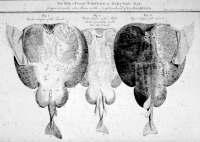
This form of neuromodulation, the electric neurostimulator, has not been around for very long. The devices that doctors implant today are extremely advanced technologically and have only come about recently. The theory of giving someone an electrical shock to cure disease has been around since the it was first used in Mesopotamia by a healer. Scribonius Largus was the healer, he used the electrical shocks that were given through the torpedo fish, a species of electric eel, to relieve pain. He did this by placing the eels in the same pool as his patients, and the electrical shocks from the eels would carry through the water and help relieve a patient's pain. This was the beggining of 'shock therapy' and would be the basis for the future, in which it would further be developed and improved.
The torpedofish used by Scribonius Largus
The Invention of the Battery
The next step in the process was how to transport this electricity, and the medical side took a backseat to the scientific fascination with electricity. This soon evolved into the battery with the work of Faraday (chem.ch.huji.ac.il/history/faraday.htm), Volta (www.italian-american.com/volta.htm) and others, which made much more electrcal research possible. Faraday was one of the main electrical researchers, and his law, that all elctrical fields an produce magnetism and the reverse, is an important rule of electricty which was the key to his work on electrical stimulation as a medical treatment. Faraday carried on the work of Benjamin Franklin (www.ushistory.org/franklin/info/index.htm), who had worked on electrical stimulation for pain relief, and around the year 1871 invented 'Faradization', in which the patients would be shocked with electricity in order to suppress pain and cure numerous other ailments.
The Gaiffe Electrical Stimulator
By 1863, before Faraday had finished his work on the theory of Faradization, there was the invention of the Gaiffe in Paris, France. The Gaiffe was the first of the modern devices, with removable batteries, lead wires and skin electrodes. It was a breakthrough invention and had only one disadvantage: its low levels of power. The Gaiffe stimulator could only provide 3 milliamperes of elctricty, as opposed to todays devices, which produce up to 90 milliamps. This made it less effective than the today's neurostimulators, but it was nearly 150 years their predecessor, making it an incredibly good and advanced device for its time.
The Gaiffe electrical stimulator
The Faradic Electrifier and the Electreat
Later, in 1882, Faraday's techniques were broadcast to the public with an advertisement in the Boston Globe newspaper, claiming the Faradic Electrifier as a cure for many diseases, including rheumatism; liver, stomach and lung problems; and paralysis. This was one of the first devices to ever use 'media medicine' and marketing hype to sell its medical products, a technique which is now used by nearly all medical businesses.
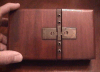
The next major invention and developement in electrical stimulation was the 'Electreat', a device invented in 1919 by Charlie Wills Kent in Peoria, Illinois. The Electreat ran on two D batteries and had sponge electrodes and a roller for application. It was a major seller, with an estimate of as many as 250 000 of the devices sold in the 25 years they were available. The Electreat's company claimed it to be 'the artificail heart' and gave it media hype rivalling and bettering that of the faradic electrifier. The company, however, was charged for insubstantial medical claims and forced to reduce thier claims to pain relief only.
Compacting of the Devices and Neurostimulation
The next major advances were the compacting of these devices, as well as better safety conditions and more efficent running with better results. The devices grew smaller, more pwerful, safer and could cure more ailments with the evolution of these devices. The advances were extremely important and necessary for growth of these devices, but the biggest advancement was definitely the neurostimulators in place of the sponge skin electrodes.
The neurostimulator implants were smaller, more effective and targeted certain areas for certain problems. This is the modern technology, the devices that are implanted today. They can target centain nerves or parts of the body for more effective relief, as they are especially calibrated to the area which needs the relief. This means that not only will the results be better, but there will also be less side effects to other areas of the body. These neurostimulators can also be implanted into the brain for some diseases or degenerative conditions. This is known as deep brain stimulation and came about in 1994. This technique is used to cure diseases such as Parkinson's and Epilepsy.
Today's modern neurostimulator device
The first implanted neurostimulator was not a deep brain stimulator (these were not created for another 30 years) and was created in 1964, but was not implanted. The inventors, Drs E.A. Spiegel and H.T. Wycis, were not given much recognition, and this is thought to be due to the device not being implanted into any trial patients coupled with the fact that it was so ahead of its time that clinicians were doubtful of its effectiveness. This doubt was not shared by all, and in 1967, the first neurostimulative device was implanted in a terminally ill cancer patient and relieved the patient's pain. This trial patient led to the implants in 6 other people by the same neurosurgeon by 1970. These devices were experimental, and while the devices worked, their placing did not. The stimulators were pain relief only devices, and as there was extremely limited knowledge of the nervous sytem at the time, were implanted at a place in the spinal cord that, when stimulated, could lead to side effects including paralysis.
From here on, the devices evoloved into what we have today. The main progression from this point was a better understanding and knowledge of the nervous system, which allowed more accuracy for implants and less side effects as well as better pain reduction and suppression of ailments.
This information was mainly sourced from The Burton Report: History of Neurostimulation Parts I & II (www.burtonreport.com/infspine/NSHistNeurostimPartI.htm & www.burtonreport.com/infspine/NSHistNeurostimPartII.htm)